


The Worlds Of Robert Heinlein
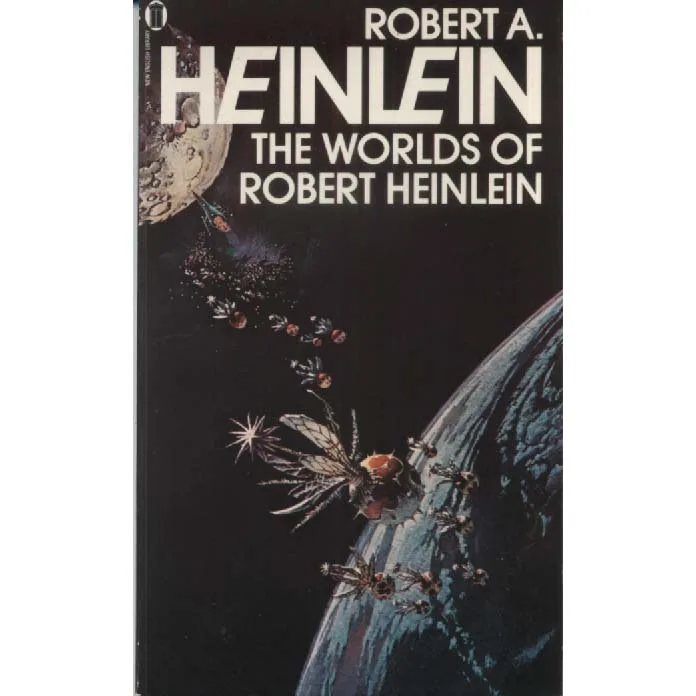
Publisher: New English Library
Format: Paperback
ISBN: 0450042413
The Worlds of Robert Heinlein (1978) – Robert A. Heinlein
Publisher: New English Library
ISBN: 0450042413
Condition: Good
Sold by: Crappy Old Books
Atomic Bombs, Uncertain Futures and the Unfortunate Discovery That Humanity May Be Its Own Worst Enemy
There was a time when the future seemed wonderfully straightforward. By the year 2000, everybody would be travelling to work in flying cars, robots would perform the household chores, humanity would have established thriving colonies on Mars, and nuclear energy would provide limitless electricity at practically no cost. The average citizen would enjoy a life of leisure, technology would solve the world’s problems, and nobody would ever again be required to spend a Saturday afternoon assembling flat-pack furniture.
Unfortunately, the future arrived and proved rather less cooperative.
We got computers, smartphones, traffic congestion, increasingly complicated household appliances and the astonishing ability to communicate instantly with somebody on the other side of the planet, principally to disagree about something neither of us understands.
Robert A. Heinlein, one of the great architects of modern science fiction, understood rather better than most that predicting the future was a dangerous occupation. Technology might advance spectacularly, but human stupidity, political ambition and the ability of governments to make unfortunate decisions appeared likely to survive every conceivable scientific breakthrough.
In The Worlds of Robert Heinlein, originally published in 1966 and presented here in its 1978 New English Library edition, the celebrated author combines speculative fiction with reflections on technological progress, political freedom and the terrifying possibilities of the atomic age.
This compact British paperback contains four stories — Free Men, Blowups Happen, Searchlight and Solution Unsatisfactory — together with Heinlein’s introductory essay Pandora’s Box, in which he considers the difficulties of predicting technological and social developments.
It is classic Heinlein: ingenious, occasionally argumentative, technically imaginative and possessed of the cheerful conviction that civilisation is probably heading towards disaster unless somebody exceptionally competent intervenes.
Naturally, the exceptionally competent person is usually one of Heinlein’s characters.
Pandora’s Box – Predicting the Future Is Easy Until It Actually Happens
The collection opens with Pandora’s Box, an essay in which Heinlein revisits earlier predictions about the future and considers how successfully they have survived the passage of time.
This is a particularly brave thing for a science fiction writer to do.
Predicting the future is an excellent occupation when nobody has yet arrived there. One can confidently announce that humanity will colonise the Moon, revolutionise transportation, transform medicine and develop marvellous new technologies, safe in the knowledge that most readers will be too busy getting on with their lives to check the results.
Revisiting those predictions years later is rather less comfortable.
Heinlein examines technological change with the perspective of someone who had witnessed extraordinary developments in aviation, nuclear physics, electronics and space exploration. The mid-twentieth century was an age in which ideas previously confined to speculative fiction were rapidly becoming reality.
Yet the future was not unfolding in an orderly manner.
Some advances arrived far sooner than expected. Others remained frustratingly distant. Social developments proved particularly difficult to anticipate, perhaps because human beings stubbornly refused to behave like the rational creatures imagined by technological optimists.
The essay provides an illuminating introduction to Heinlein’s broader concerns and an entertaining reminder that scientific progress does not necessarily produce predictable consequences.
Indeed, it sometimes seems that the more sophisticated humanity becomes, the more inventive it grows in finding entirely new ways to create problems.
Free Men – Resistance Is Not Necessarily Futile
In Free Men, Heinlein explores a grim future in which the United States has fallen under foreign occupation and resistance has become a dangerous necessity.
This is not a world of comfortable democratic institutions, reassuring political speeches and politicians solemnly promising that everything is under control.
The country has been conquered, freedom has been suppressed, and those unwilling to accept defeat must organise themselves against overwhelming power.
The story follows members of an underground resistance movement struggling to preserve the possibility of liberation.
Heinlein brings his characteristic interest in personal responsibility, military organisation and individual courage to a scenario in which freedom has ceased to be an abstract political principle and become something for which people are prepared to risk their lives.
It is an uncomfortable subject, particularly because the story suggests that civilised societies cannot necessarily assume their institutions will protect them indefinitely.
Liberty, in Heinlein’s universe, is not something guaranteed by the existence of an impressive constitution, a national anthem and several hundred politicians congratulating themselves on the achievements of previous generations.
It is something that may occasionally require defending.
The result is a tense and politically charged adventure that reflects the anxieties of its era while raising questions about patriotism, resistance and the price of independence.
It also demonstrates Heinlein’s recurring suspicion that a determined collection of capable individuals may accomplish rather more than an enormous institution equipped with a magnificent headquarters and an unlimited stationery budget.
Blowups Happen – The Atomic Age Has a Few Minor Teething Problems
Nuclear energy is a remarkable achievement.
By manipulating the fundamental forces of nature, humanity discovered how to release extraordinary amounts of energy from quantities of matter that would previously have appeared quite insignificant.
This was a magnificent scientific breakthrough, although the discovery came with the unfortunate complication that some nuclear processes could also produce explosions of a rather discouraging magnitude.
In Blowups Happen, first published in 1940, Heinlein imagines the psychological and practical difficulties involved in operating an enormously powerful nuclear installation.
The personnel responsible for maintaining the facility face exceptional pressure. The technology is dangerous, the consequences of failure potentially catastrophic, and the people required to operate it are human beings rather than perfectly reliable mechanical components.
This creates something of a problem.
A machine may be designed with elaborate safety systems, but its operators remain vulnerable to exhaustion, anxiety, error and the persistent psychological discomfort of knowing that a mistake could have rather more serious consequences than accidentally deleting the office spreadsheet.
Heinlein examines the interaction between advanced technology and human limitations, producing a story that anticipates concerns about nuclear safety, operational stress and the management of hazardous systems.
What makes the premise particularly fascinating is its historical timing.
Written before the first controlled nuclear chain reaction and before the atomic bomb, the story reflects an era when the practical possibilities of nuclear technology were only beginning to emerge.
Heinlein was imagining the problems of an atomic future before that future had properly arrived.
And unlike the manufacturers of certain modern electrical appliances, he seemed to appreciate that introducing an extraordinarily powerful new technology might require rather more consideration than simply supplying a warning label.
Searchlight – A Small Voice in an Enormous Universe
After the grand political and technological anxieties of the other stories, Searchlight offers a more intimate adventure centred on an extraordinary rescue problem.
A blind young girl has become lost on the Moon, and the challenge of locating her in the vast lunar landscape demands ingenuity rather than brute force.
The story combines science, practical reasoning and human compassion in a demonstration of Heinlein’s talent for constructing problems that can be solved through intelligence and unconventional thinking.
The Moon is not an especially forgiving environment in which to misplace somebody.
There are no convenient roadside cafés, friendly passing motorists or reassuring signs indicating that the nearest railway station is only half a mile away.
There is an immense landscape, considerable danger and a pressing need to devise a solution before circumstances become fatal.
What follows is an elegant example of the problem-solving science fiction for which Heinlein became famous.
The story is relatively short, but its appeal lies in the way technical imagination is brought into the service of an immediate human need.
It is also a reminder that science fiction need not always involve galactic warfare, sinister alien civilisations or vast political conspiracies.
Sometimes the most compelling drama concerns a single vulnerable person and the determination of others to bring her home.
And sometimes the difference between catastrophe and survival is simply the ability to think of an answer that nobody else has considered.
Solution Unsatisfactory – Congratulations, You’ve Invented the Ultimate Weapon. Now What?
Of all the stories in this collection, Solution Unsatisfactory is perhaps the most chilling in its implications.
Written in 1940 and published in 1941, before the United States entered the Second World War, the story imagines the development of an extraordinarily destructive weapon based upon radioactive materials.
The scientific breakthrough creates an apparently irresistible military advantage.
Unfortunately, possessing a weapon capable of overwhelming an enemy raises a rather awkward question: what happens after you have demonstrated that such a weapon exists?
Can overwhelming destructive power guarantee peace? Can governments be trusted to exercise restraint? Can international order be maintained through the threat of annihilation? And what happens when other nations inevitably attempt to acquire similar capabilities?
Heinlein constructs a scenario in which technological superiority threatens to transform the entire structure of world politics.
The title is particularly appropriate.
The proposed answer to the problem of war creates new problems of its own, and the prospect of lasting peace becomes inseparable from coercion, fear and extraordinary concentrations of power.
It is a striking example of science fiction anticipating the dilemmas that would dominate international relations after the development of nuclear weapons.
The story does not merely speculate about a devastating new technology. It examines the political consequences of possessing it.
This is where Heinlein becomes especially interesting.
The discovery itself is only the beginning. The more difficult problem concerns what human beings will do with it, particularly when those human beings include governments, military authorities and political leaders convinced that history has appointed them to make decisions on everybody else’s behalf.
One might reasonably conclude that humanity should have developed greater wisdom before acquiring weapons of unprecedented destructive power.
Unfortunately, technological progress has never shown much inclination to wait for moral improvement.
The Future According to Heinlein: Brilliant Machines, Questionable People
Taken together, these stories demonstrate several of the qualities that made Robert A. Heinlein such an influential figure in twentieth-century science fiction.
His work combines technical imagination with questions about political authority, personal freedom, scientific responsibility and the practical difficulties of survival.
He was fascinated by the consequences of innovation rather than merely the machinery itself.
A nuclear reactor is interesting, but what does operating it do to the people responsible? A revolutionary weapon is impressive, but what does it do to international politics? A lunar expedition is extraordinary, but how do people overcome a crisis when they are surrounded by an unforgiving environment?
And if freedom is threatened, what responsibilities fall upon individuals who refuse to surrender it?
Heinlein frequently approached such questions with the confidence of a man who had carefully considered the situation and concluded that most of the people in charge were probably idiots.
His characters tend to value competence, initiative and independence. They are often engineers, scientists, military personnel or other practically minded individuals capable of solving problems while lesser mortals are still organising a meeting to discuss the possibility of forming a committee.
This can make his fiction wonderfully entertaining.
It can also make it gloriously argumentative.
Heinlein was never particularly interested in writing stories that left every reader feeling comfortable, reassured and thoroughly satisfied that their existing political opinions had been confirmed.
He preferred to challenge assumptions, explore uncomfortable possibilities and occasionally deliver a philosophical lecture disguised as an adventure.
For readers who enjoy science fiction with ideas behind the machinery, this is very much part of the attraction.
Science Fiction From the Days When Seventy-Five Pence Could Buy You Several Catastrophes
There is something particularly appealing about the 1978 New English Library paperback editions of classic science fiction.
These were books produced for readers who wanted adventure, intellectual stimulation and a reasonably portable selection of extraordinary possibilities without having to invest in a gigantic hardback edition requiring its own shelf reinforcement.
This particular edition runs to approximately 127 pages, making it a compact but substantial introduction to several different aspects of Heinlein’s imagination.
It belongs to an era when British paperback publishers enthusiastically brought American science fiction to a new generation of readers, often accompanied by wonderfully dramatic cover artwork suggesting that absolutely anything might be happening inside.
The New English Library editions have their own nostalgic appeal, especially for collectors who remember discovering Heinlein, Asimov, Clarke, van Vogt and other giants of the genre on second-hand bookshop shelves.
They represent a period when science fiction was increasingly recognised as a serious literary vehicle for exploring scientific and social ideas, while still retaining its enthusiasm for spaceships, dangerous experiments and situations in which civilisation might be destroyed before the final chapter.
This volume is also interesting because it captures Heinlein’s work across several decades, from the early nuclear anxieties of the 1940s to the more developed space-age imagination of the 1960s.
For established enthusiasts, the collection provides an opportunity to revisit important shorter works. For newcomers, it offers an accessible introduction to his distinctive combination of speculative technology, political argument and adventurous storytelling.
And unlike the technologies imagined in some of these stories, the paperback requires no power supply, operating system, software subscription or complicated international regulatory framework.
You simply open it.
An astonishingly efficient technology, really.
Robert A. Heinlein – A Man Who Had Some Concerns About the Future
Robert A. Heinlein remains one of the most significant figures in the history of modern science fiction.
Alongside writers such as Isaac Asimov and Arthur C. Clarke, he helped establish the genre as a means of exploring scientific possibilities and their implications for human society.
His fiction ranged from adventures for younger readers to provocative novels examining politics, individual freedom, sexuality, religion, military organisation and the future of civilisation.
Heinlein’s work could be optimistic about human ingenuity while remaining deeply suspicious of human institutions.
He believed in the transformative possibilities of knowledge and competence, yet frequently imagined futures in which scientific advances created dangerous new concentrations of power.
His stories often suggest that the real danger lies not in the machinery but in the people controlling it.
A nuclear reactor does not have political ambitions. A spacecraft does not seek re-election. A revolutionary scientific discovery does not automatically appoint itself ruler of the planet.
Human beings, however, have demonstrated a remarkable willingness to do all these things on one another’s behalf.
And this is why Heinlein’s older fiction can still feel surprisingly relevant.
We may now possess technologies that would have astonished his contemporaries, but our political and social problems remain disconcertingly familiar.
The machines have become faster, smaller and more sophisticated.
The people operating them have not necessarily improved at the same rate.
About This Copy
This is the 1978 New English Library edition of The Worlds of Robert Heinlein by Robert A. Heinlein, ISBN 0450042413.
Condition: Good. A previously owned copy showing the ordinary signs of reading, handling and age consistent with its condition grading. A respectable vintage paperback that has survived several decades of technological development, economic uncertainty and changing literary fashions without requiring a nuclear-powered preservation system.
Available from Crappy Old Books, where we believe that good science fiction deserves to survive longer than most of the predictions made by its authors, and that a proper old paperback is considerably more satisfying than a digital file that disappears when somebody changes a licensing agreement.
An entertaining and thought-provoking collection of classic Heinlein fiction exploring nuclear catastrophe, political freedom, technological responsibility, lunar survival and the uneasy relationship between human intelligence and human judgement.
Recommended for Robert A. Heinlein enthusiasts, collectors of vintage New English Library paperbacks, fans of Golden Age science fiction and anyone who enjoys stories in which civilisation is repeatedly placed in extraordinary danger by the very people supposedly responsible for protecting it.
It is also a useful reminder that the great science fiction writers did not always predict the future accurately, but they were often remarkably successful at identifying the problems humanity would continue to create for itself.
Heinlein imagined a world transformed by nuclear power, extraordinary technology and humanity’s expansion beyond Earth.
Nearly half a century after this edition appeared, we have indeed achieved astonishing things.
We have landed machines on Mars, developed artificial intelligence and built an international communications network connecting billions of people.
And what have we done with these remarkable achievements?
Among other things, we have developed refrigerators that send notifications, televisions that insist upon knowing our email addresses, and software that requires an update before it will allow us to perform a task it performed perfectly well yesterday.
Perhaps Heinlein was right to worry.
The future arrived, but somebody appears to have forgotten to check whether it was actually an improvement.
Keep browsing: See more Science-Fiction books Other books by Robert A Heinlein
